One of the most strategic decisions that a global business can make nowadays is to expand its workforce into India. India has huge potential with a huge talent base, competitive pay and emerging digital economy. However, the journey between hired and productive employee is paved with legal, statutory and cultural demands that fumble even the seasoned HR managers.
That is where EOR Services or Employer of Record solutions, will prove to be necessary. An Employer of Record India model enables foreign firms to hire Indian talent legally without implementing a local firm, whereas the EOR takes all statutory liabilities. However, what exactly does the onboarding process look like, in detail? And what do the majority of guides neglect to tell you?
Let’s break it all down.
Why Onboarding in India Is Different
Most global onboarding articles treat India as just another geography on a dropdown menu. It isn’t. India has:
- 28 states and 8 Union Territories, each with its own labor laws, professional tax slabs, and Shop and Establishment Act requirements
- A dual social security system under the Employees’ Provident Fund (EPF) and Employees’ State Insurance (ESI)
- Mandatory compliance with the POSH Act (Prevention of Sexual Harassment) from the very first day of employment
- Background verification norms that include police verification in certain industries
- Strict rules around probation periods, notice periods, and gratuity eligibility that begin accumulating from day one
Overlooking any of these during Employee Onboarding in India can expose your organization to retroactive penalties, employee disputes, or regulatory scrutiny.
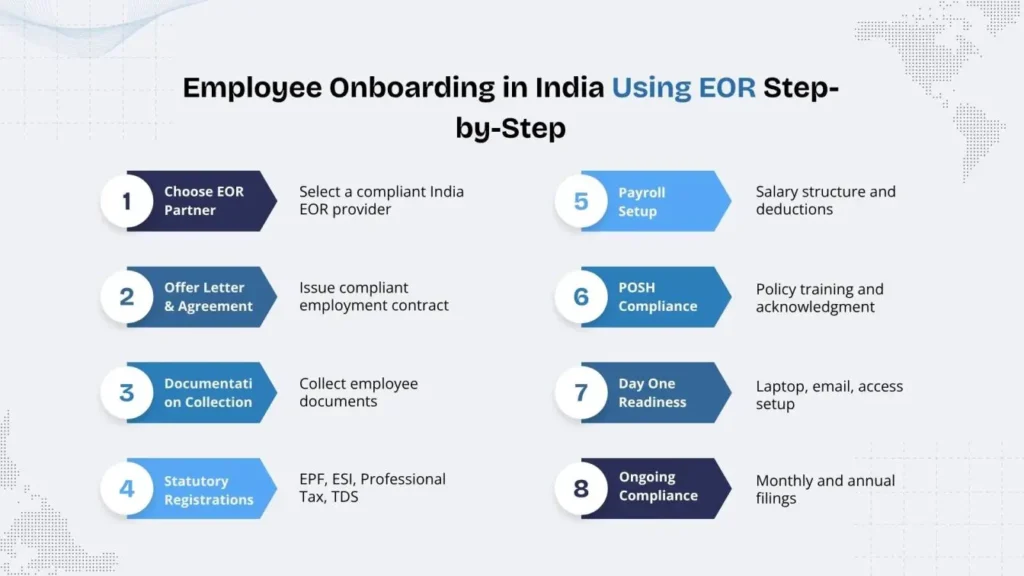
Step 1: Choosing the Right EOR Partner
Even prior to the first offer letter being signed, the decision you make in regard to your EOR provider defines the difference between smooth and chaotic operations in India. Not every EOR Services are the same. When considering providers, seek:
- Existing in-country legal entities in key Indian states.
- Proven awareness of the compliance with the Indian labor laws.
- Robust payroll infrastructure for payroll processing India-wide, including multi-state tax handling
- Ability to handle statutory benefits India needs – PF, ESI, gratuity, and bonus requirements.
- Clear SLAs to onboarding schedules (on average 3-7 business days in India to hire somebody compliantly).
A well-established EOR removes the burden of local entity setup, which can take 3–6 months and require significant capital investment.
Step 2: Offer Letter and Employment Agreement
After a candidate has been chosen, the EOR signs and issues the employment contract in accordance with the Indian law. This document is more nuanced than a standard Western contract. It must include:
- Open-ended or fixed-term type of employment (Labor codes in India distinguish between these sharply)
- Salary disbursement: Basic pay, HRA (House Rent Allowance), Special allowance and statutory deductions.
- Probation period provision: 3-6 months on average; the rules of termination vary greatly during probation.
- Termination: 30-90 days (generally) based on seniority and industry.
- Gratuity note: Under the Payment of Gratuity Act, employees can receive gratuity after five years of uninterrupted service.
- Non-compete and IP assignment agreements: Only enforceable within limited legal frames in India.
The EOR makes sure that the contract meets the needs of the client company and the state-specific labor regulations applicable to the particular contract – a generic global template cannot achieve this.
Step 3: Collecting New Hire Documentation
New hire documentation India requirements are specific. The EOR will collect:
- Aadhaar card (national identity) — mandatory for PF and ESI enrollment
- PAN card — essential for income tax deduction (TDS)
- Bank account details for salary disbursement
- Previous employment documents: Relieving letter, experience certificate, last payslip
- Educational certificates (especially for roles requiring verified qualifications)
- Address proof for statutory registrations
- Passport and visa for foreign nationals being onboarded in India
This documentation phase also triggers background verification India processes, employment history checks, criminal record checks, and in some sectors, police verification as mandated by state law.
Step 4: Statutory Registrations and Enrollment
This is the most compliance-heavy phase of Employee Onboarding in India, and where the real value of EOR Compliance capabilities shines.
EPF (Employee Provident Fund) Enrollment:
- Mandatory for employees earning a basic salary up to ₹15,000/month; optional beyond that
- Employee contributes 12% of basic salary; employer matches it
- UAN (Universal Account Number) generation is required for every new employee
ESI (Employees’ State Insurance) Enrollment:
- Applicable for employees earning up to ₹21,000/month (₹25,000 for persons with disabilities)
- Covers medical, maternity, disability, and dependent benefits
- Requires IP (Insured Person) number generation
Professional Tax:
- A state-specific tax levied in states like Maharashtra, Karnataka, West Bengal, and others
- Slabs vary widely; the EOR must compute and deduct the correct amount based on the employee’s work location
TDS (Tax Deducted at Source):
- The EOR calculates applicable income tax deductions under the Income Tax Act from the very first payroll cycle
Shop and Establishment Act Registration:
- Required at the state level; the EOR manages this for remote/WFH employees based on their registered work address
This entire statutory enrollment cycle, when handled by a capable EOR Services provider, typically completes within the onboarding week, preventing gaps in employee coverage.
Step 5: Payroll Setup and First-Month Processing
Payroll processing India is not just about cutting a cheque. The EOR sets up:
- The salary structure optimized for tax efficiency (splitting CTC into tax-exempt components like HRA, LTA, and meal allowances)
- Monthly TDS computation, considering the employee’s declared investment proofs
- Leave policy configuration in line with the Factories Act, Shops and Establishments Act, or sector-specific rules
- Full and Final Settlement process mapping for future offboarding
The first payroll run is critical. Errors here wrong PF deductions, missing professional tax, incorrect TDS; create compounding compliance issues.
Step 6: POSH Compliance and Mandatory Policy Orientation
This is what most onboarding guides fail to take into consideration: POSH compliance is not a choice or something that can be dealt with at a later time.
Under the Sexual Harassment of Women at Workplace (Prevention, Prohibition and Redressal) Act, 2013, every employer including those operating through an EOR must:
- Constitute an Internal Committee (IC) or designate a Local Complaints Committee contact
- Provide POSH awareness training to all employees at the time of joining
- Ensure the new hire signs an acknowledgment of the POSH policy
This will be part of the digital onboarding process via a Learning Management System (LMS) module by a good EOR Services provider.
Additional policies that must be communicated and acknowledged during onboarding:
- Code of Conduct
- Data Privacy and IT Security Policy (especially important for remote hiring India scenarios)
- Work-from-home policy India terms, if applicable
- Leave and Attendance Policy
- Grievance Redressal Mechanism
Step 7: Equipment, IT Access, and Day-One Readiness
Remote hiring India has normalized the concept of virtual day-one readiness. The EOR coordinates with the client company to ensure:
- Laptop/device provisioning: Either through the client’s logistics team or EOR-facilitated hardware procurement
- Email and system access: The EOR shares the employee’s onboarding information with the client’s IT team for timely credential creation
- Communication tools setup: Access to Slack, Teams, or equivalent platforms
- Org chart and team introduction: A structured welcome pack sent digitally
This step is often underestimated but directly impacts employee experience and early engagement.
Step 8: Ongoing EOR Compliance Monitoring
Onboarding doesn’t end on day one. EOR Compliance is a continuous responsibility. A good EOR will:
- File monthly and quarterly returns for PF, ESI, TDS, and professional tax
- Maintain updated records for any mid-year CTC revisions or promotions
- Track annual compliance deadlines: Investment proof collection (January–March), Form 16 issuance (June), and bonus payment under the Payment of Bonus Act (typically within 8 months of the financial year end)
- Monitor amendments to Indian labor codes, the four consolidated labor codes (Wage Code, Industrial Relations Code, Social Security Code, Occupational Safety Code) are in various stages of state-level implementation
Staying ahead of these changes is a full-time job that EOR Services providers are structurally built to handle.
Key Advantages of Using an EOR for India Onboarding
- Speed: Hire and onboard talent in India within days, not months
- Risk Mitigation: Full EOR Compliance coverage eliminates legal exposure for the client company
- Cost Efficiency: No entity setup costs, no dedicated local HR or legal team required
- Scalability: Onboard one employee or one hundred using the same compliant framework
- Local Expertise: Navigate state-specific nuances in Indian labor law compliance with confidence
In India, Employee Onboarding is a rewarding process. When they have the appropriate EOR Services partner, foreign companies can develop high-performing Indian teams without even missing a day of compliance uncertainty.
Let Transparian Support Your India Hiring Needs
Transparian offers professional EOR and HR services to organisations expanding into India, including EOR Compliance and Human Resources management in India and Employee Onboarding. Transparian assists businesses in hiring confidently, remaining compliant and developing high-performing Indian teams, without the complexity of operations, through hands-on guidance and in-depth local expertise.
FAQ’s
Employee onboarding in India using EOR services refers to hiring and onboarding employees through an Employer of Record that manages payroll, compliance, taxes, and statutory obligations without requiring a local entity.
Employee onboarding through EOR services in India typically takes 3 to 7 business days, depending on documentation, background verification, and statutory registrations.
Yes, foreign companies can hire employees in India without setting up a legal entity using EOR services. The EOR becomes the legal employer and handles compliance, payroll, and HR operations.
Yes, under the Sexual Harassment of Women at Workplace Act, companies must provide POSH policy awareness and ensure employee acknowledgment from the first day of employment.
Employees’ Provident Fund and Employees’ State Insurance are mandatory social security schemes that provide retirement, medical, and insurance benefits to eligible employees.
Yes, EOR providers manage ongoing compliance such as:
Monthly payroll filings
Tax deductions
PF and ESI filings
Annual tax documents
Labor law updates
This ensures long-term compliance for foreign companies hiring in India.