Expanding into new markets is now accessible to startups, SMEs, and growing enterprises, not just large multinationals. However, international expansion introduces legal, payroll, tax, and compliance challenges that are often underestimated. In this context, an employer of record serves as a strategic partner, not merely a service provider.
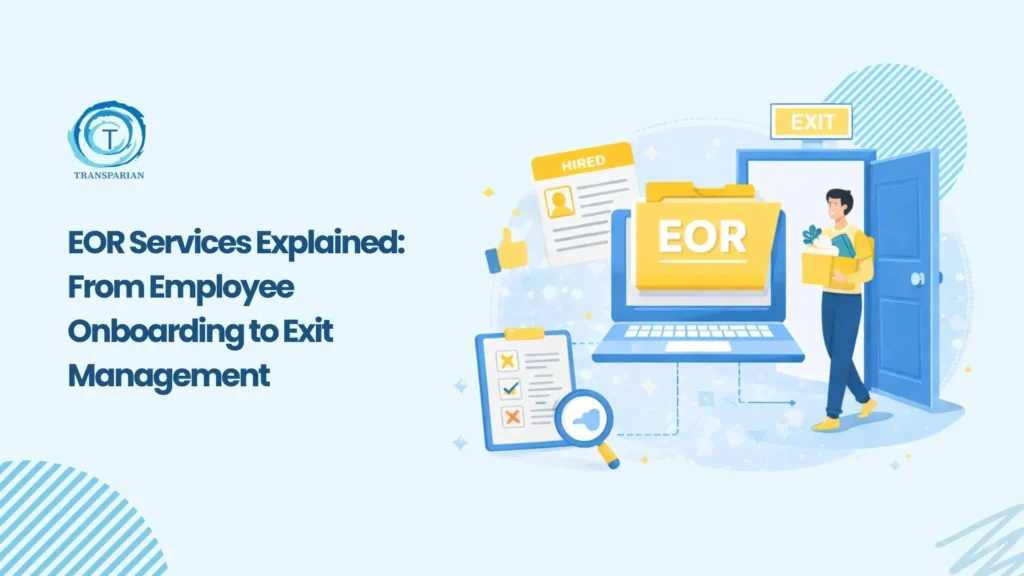
Understanding how EOR services operate from hiring through exit enables companies to build compliant, scalable, and efficient global teams. This guide outlines the complete lifecycle of employer of record services, addressing both common topics and often-overlooked operational details.
What Is an Employer of Record?
An employer of record is a third-party organization that legally employs workers on behalf of another company. The client company oversees daily tasks, performance, and operations, while the EOR assumes responsibility for statutory obligations as the legal employer.
This structure enables compliant cross-border employment without requiring a local legal entity. A global EOR model allows businesses to hire talent in multiple countries efficiently and in accordance with local laws.
An EOR handles:
- Employment contracts
- Work permits (where applicable)
- Statutory benefits
- Tax withholdings
- International payroll management
- Labor law adherence
- Employee exits
This arrangement supports comprehensive global hiring solutions and reduces administrative burdens.
Why Businesses Choose EOR Services
MMany companies believe EORs are only suitable for early-stage market entry, but they serve several strategic purposes:Testing new markets without incorporation
- Hiring remote specialists in niche talent markets
- Supporting project-based international expansion
- Managing risk exposure in unfamiliar jurisdictions
- Streamlining HR outsourcing operations
EORs simplify employment law compliance, particularly in countries with complex labor codes, mandatory benefits, and strict termination requirements.
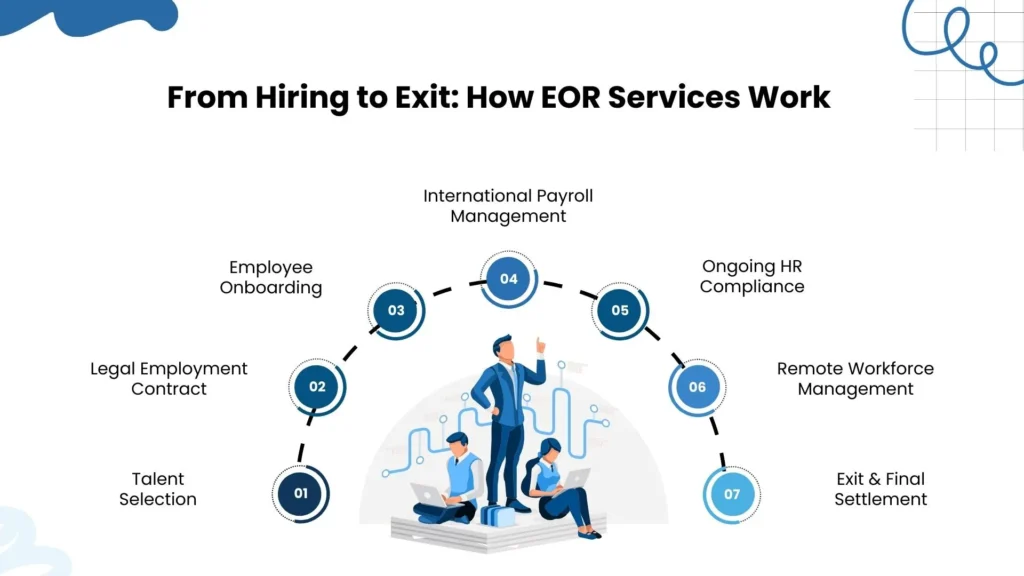
Phase 1: Employee Onboarding Through an EOR
1. Offer Letter & Employment Contracts
Once a candidate is selected, the EOR provider drafts a locally compliant employment agreement aligned with national labor laws. This ensures inclusion of appropriate clauses regarding:
- Probation
- Notice period
- Leave entitlements
- Confidentiality
- Intellectual property
This stage is essential for HR compliance, as even minor contractual errors may result in penalties.
2. Statutory Registrations
The EOR registers the employee with relevant authorities for:
- Tax identification
- Social security
- Health insurance
- Pension schemes
This process supports structured international payroll management and ensures lawful employment from the outset.
3. Employee Benefits Administration
A reliable EOR company manages both mandatory and optional benefits, including:
- Health insurance
- Retirement contributions
- Paid leave
- Maternity/paternity benefits
Some advanced providers also design competitive benefits packages aligned with local standards as part of a broader international HR strategy.
4. Onboarding Remote Teams Effectively
Beyond paperwork, successful onboarding remote teams includes:
- Digital documentation workflows
- Local compliance briefings
- Cultural alignment support
- Time-zone coordination strategies
Many resources focus solely on legal onboarding, but effective remote integration requires structured communication plans and performance frameworks. Remote workforce management is essential in this context.
Phase 2: Managing Employees During Employment
After onboarding, the EOR’s role continues throughout the employment lifecycle.
Payroll & Tax Management
Accurate and timely payroll is a cornerstone of employer of record services. This includes:
- Monthly salary processing
- Tax deductions
- Currency conversions
- Payslip generation
- Statutory filings
Robust international payroll management ensures employees are paid accurately and the company remains compliant with local tax authorities.
Ongoing HR Compliance
Labor laws change frequently. A global eor continuously monitors regulatory updates affecting:
- Minimum wage laws
- Working hour limits
- Overtime calculations
- Leave policies
- Data protection rules
Proactive employment law compliance prevents disputes and fines.
Leave & Attendance Administration
Tracking annual leave, sick leave, and public holidays across multiple countries is complex. EORs use structured systems to manage localized leave frameworks in accordance with national laws.
Risk Management in HR
Risk management in HR is often overlooked. This includes:
- Misclassification prevention
- Permanent establishment risk mitigation
- Workplace harassment compliance
- Health & safety regulations
- Employee grievance handling
An experienced employer of record reduces exposure to employment litigation, especially in highly regulated markets.
Phase 3: Performance, Mobility & Expansion Support
While EORs do not manage employee performance, they support compliance in areas such as:
- Promotions and contract amendments
- Salary revisions
- Bonus structures
- Cross-border employee transfers
If a company transitions from EOR to entity setup, some providers assist with employee migration strategies as part of a broader global hiring solutions framework.
They also help companies develop sustainable remote workforce management models that align with local labor expectations.
The Overlooked Topic: Permanent Establishment Risk
One major topic often missed in general discussions is Permanent Establishment (PE) risk. When employees operate in a foreign country, authorities may determine that the company has created a taxable presence.
Through structured legal employer services, EORs help mitigate PE risks by ensuring clear contractual boundaries between the employee, the EOR, and the client company.
This becomes critical in shaping a compliant international HR strategy.
The Role of Technology in EOR Services
Modern EOR services integrate digital tools for:
- Automated payroll processing
- Compliance tracking dashboards
- Document storage
- Employee self-service portals
Technology-driven platforms enhance transparency in HR outsourcing and strengthen reporting capabilities for finance teams.
Phase 4: Employee Exit & Offboarding Management
Employee exits are one of the most legally sensitive aspects of global employment.
Lawful Termination Processes
Each country has unique termination regulations involving:
- Notice periods
- Severance calculation
- Grounds for dismissal
- Documentation requirements
An experienced EOR company ensures terminations comply with local labor laws to maintain full employment law compliance.
Final Payroll & Settlements
Exit management includes:
- Final salary disbursement
- Unused leave encashment
- Bonus settlement
- Tax clearance documentation
Accurate international payroll management helps prevent post-employment disputes.
Risk Mitigation During Exit
Improper termination can lead to lawsuits. Structured risk management in HR ensures:
- Documentation is complete
- Legal procedures are followed
- Exit interviews are compliant
- Data access is revoked securely
This comprehensive approach minimizes operational disruption.
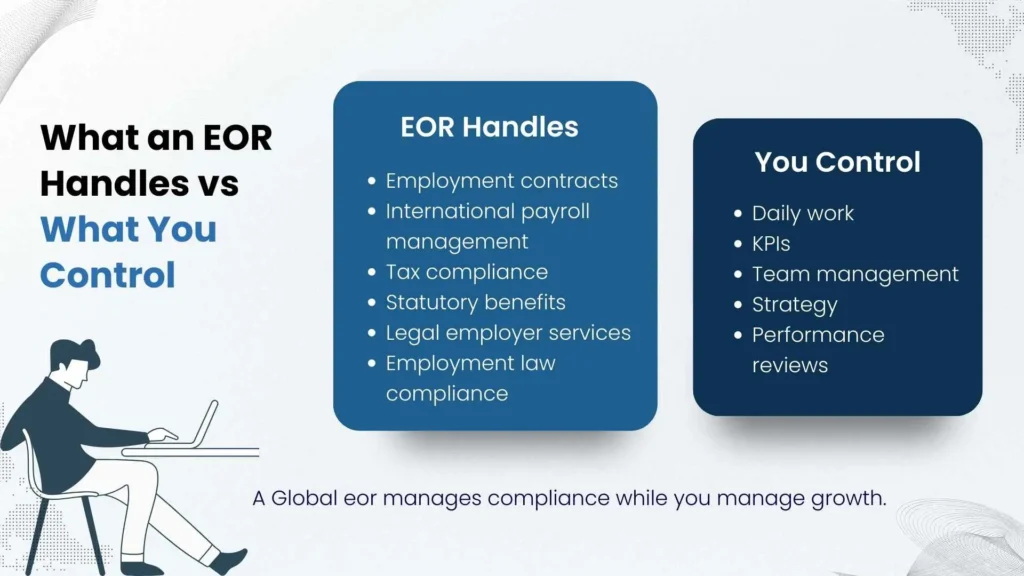
EOR vs. Traditional HR Outsourcing
Many companies confuse EOR with standard HR outsourcing, but the key difference is legal responsibility.
- In HR outsourcing, the client company remains the legal employer.
- As an employer of record services, the EOR becomes the legal employer on paper.
This distinction significantly impacts compliance, taxation, and liability.
Supporting Long-Term International HR Strategy
Beyond immediate hiring, EORs support scalable international HR strategy planning. Businesses can:
- Enter new markets quickly
- Assess workforce viability
- Transition to entity setup later
- Build distributed leadership teams
This flexibility strengthens long-term global hiring solutions and operational agility.
Challenges to Consider
While EORs offer flexibility, companies should consider:
- Service fees vs. entity setup cost
- Data security protocols
- Local partner reliability
- Scalability in multiple regions
Selecting the right global EOR partner ensures consistent service quality across jurisdictions.
Building Compliant Remote Teams at Scale
As distributed work becomes standard, remote workforce management requires:
- Clear reporting structures
- Localized employment contracts
- Centralized payroll systems
- Country-specific benefits alignment
EORs provide integrated frameworks that simplify onboarding remote teams while maintaining compliance.
The Strategic Advantage of Legal Employer Services
The true value of legal employer services lies in risk mitigation. By transferring statutory responsibilities to an experienced employer of record, companies can focus on growth rather than regulatory complexity.
From employee onboarding to exit settlements, a structured EOR model ensures operational continuity, accurate international payroll management, and seamless cross-border employment.
Expanding globally doesn’t have to be legally overwhelming. With the right eor services partner, businesses can confidently hire, manage, and transition employees across borders while maintaining full HR compliance and a structured risk management framework.
For organizations seeking compliant global expansion and scalable workforce solutions, Transparian provides reliable, structured, and future-ready EOR frameworks tailored for sustainable international growth.
FAQ’s
EOR services enable businesses to hire internationally without setting up a local entity. They provide compliant Global hiring solutions, manage contracts, and ensure smooth cross-border employment processes
An eor company manages employment contracts, International payroll management, statutory benefits, tax filings, and HR compliance, along with onboarding and exit procedures.
An EOR handles compliant employment contracts, tax registrations, benefits enrollment, and documentation. They also support employee onboarding and assist with onboarding remote teams across different countries.
EOR providers stay updated with local labor regulations, tax laws, and statutory requirements. This ensures complete employment law compliance and reduces regulatory risks.
The EOR manages lawful termination procedures, notice periods, severance calculations, and final settlements. This structured approach supports proper risk management in HR.
Startups, growing businesses, remote-first companies, and enterprises expanding internationally can benefit from eor services, especially when building a distributed workforce and implementing a long-term international HR strategy.