As Indian businesses scale beyond borders, hire distributed teams, and support international clients, workforce models have become a strategic decision rather than an operational one. One of the most important questions leadership teams face today is whether to choose an Employer of Record (EOR) model or rely on traditional outsourcing. Both approaches solve different problems. The challenge lies in understanding how each model affects compliance, cost control, workforce ownership, and long-term growth especially in the Indian and global context.
Understanding the Two Workforce Models
What Is an Employer of Record?
An employer of record is a third-party organization that legally employs workers on behalf of a business. Through employer of record services, the EOR manages employment contracts, statutory obligations, payroll, and benefits, while the business retains full control over day-to-day responsibilities, performance, and deliverables.
For companies hiring across borders, eor services simplify compliance by handling local employment requirements in each country. A global eor enables businesses to hire talent internationally without setting up a legal entity, supporting entity-free global hiring and faster market entry.
What Is Traditional Employment Outsourcing?
Employment outsourcing involves engaging an external vendor to deliver specific roles, services, or projects. The outsourcing partner hires and manages the workforce, while the client focuses on outputs rather than direct employee management. This model is often grouped under HR outsourcing, though traditional outsourcing typically extends beyond HR administration into operational delivery.
Workforce Control and Operational Ownership
People and process control is a determination of most organizations. Employees through an employer of record act as a continuation of your inside force. You establish roles, performance parameters, reporting lines and working hours. This structure enables strong workforce integration, better collaboration, and clearer accountability.
Traditional outsourcing delegates the operational control to the vendor. Although this can be effective in work-based or non-core work, it may restrict flexibility in the situations when tasks demand close coordination, quick decisions, or strong commitment to the business goals.
Compliance and Legal Responsibility in India and Globally
Compliance is one of the most critical and often underestimated considerations.
EOR and Employment Compliance
An EOR assumes responsibility for eor compliance, including:
- Employment contracts
- Statutory registrations
- Payroll processing and tax filings
- Social security and statutory benefits
For international hiring, global employment law compliance becomes significantly more complex. Employment laws vary widely by country in areas such as termination rules, notice periods, employee classifications, and mandatory benefits. A global eor manages these obligations locally, reducing exposure to legal and regulatory risk.
Outsourcing and Compliance Exposure
In outsourcing arrangements, legal responsibility can become fragmented. When outsourced workers operate like internal employees, businesses may face risks related to misclassification, co-employment, and regulatory scrutiny. These risks can have financial, legal, and reputational consequences if not carefully managed.
Payroll Structure and Cost Visibility
Payroll Cost Management Through EOR
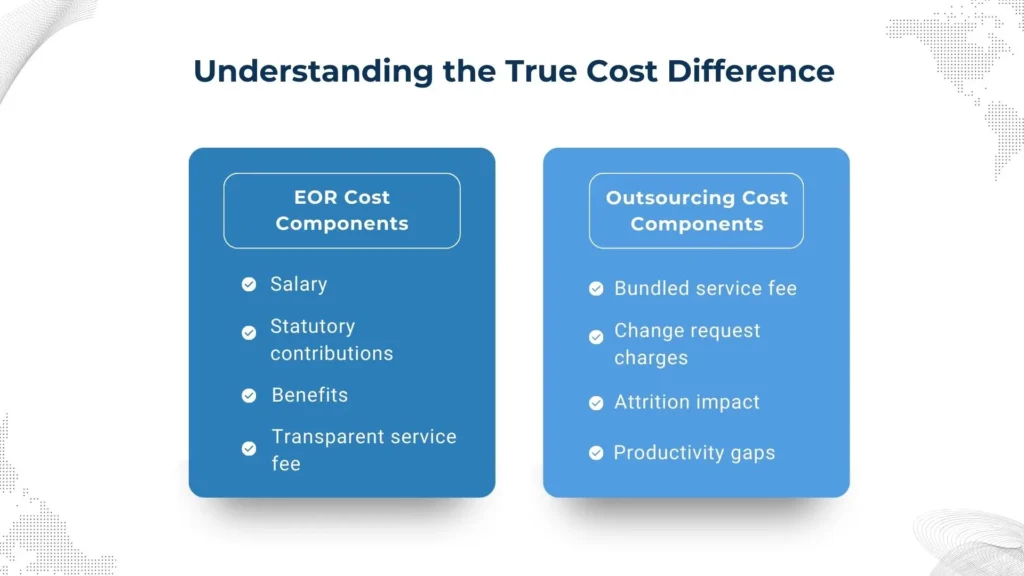
With an EOR model, payroll cost management is structured and predictable. Businesses benefit from:
- Clear monthly cost visibility
- Accurate statutory deductions
- Centralized payroll administration
- Reduced risk of penalties and errors
This clarity allows finance teams to plan budgets effectively while scaling teams across regions.
Cost Considerations in Outsourcing
Outsourcing pricing is often bundled, which can make direct cost comparisons challenging. While it may reduce upfront administrative effort, indirect costs can arise from attrition, productivity gaps, change requests, and limited flexibility in workforce planning.
For long-term or strategic roles, these hidden costs can outweigh initial savings.
Employee Onboarding and Experience
Onboarding Through an Employer of Record
An EOR provides structured employee onboarding aligned with local labor laws and company policies. Employees receive compliant contracts, access to statutory and supplemental employee benefits, and clarity around roles and expectations from day one.
This approach supports engagement, trust, and retention particularly important in competitive talent markets.
Employee Experience in Outsourcing Models
In traditional outsourcing, employee experience is shaped primarily by the vendor’s policies. This can lead to disconnects in culture, communication, and career development. Over time, these gaps may impact motivation, quality of work, and continuity.
Strategic Workforce Planning and Long-Term Growth
Workforce decisions influence long-term business outcomes.
An EOR model supports strategic workforce planning by enabling organizations to:
- Build permanent global teams
- Scale hiring in new markets without entity setup
- Transition employees to a local entity when required
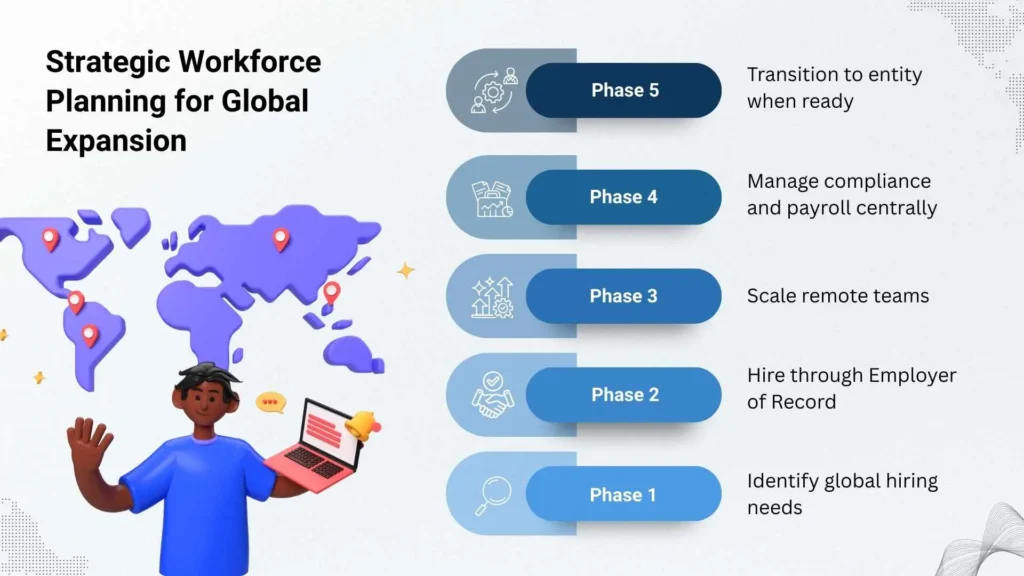
This flexibility is essential for businesses pursuing global workforce expansion while maintaining control and compliance.
Outsourcing is more suitable for short-term needs, project-based work, or non-core functions. Using it as a substitute for long-term hiring can limit leadership visibility, succession planning, and organizational capability building.
Remote Workforce Management and Performance
With distributed teams becoming the norm, remote workforce management must balance autonomy with accountability.
Under an EOR structure, employees report directly to company managers. Performance management, feedback cycles, and goal setting mirror internal processes, while HR administration is handled externally.
In outsourcing models, reporting lines are often indirect. This can slow decision-making, reduce transparency, and create dependency on vendor processes for performance management.
Data Protection, IP Ownership, and Business Risk
Clear ownership of intellectual property and data security is essential.
Employment contracts under an EOR clearly establish IP ownership with the client company. Confidentiality obligations and data protection requirements are enforceable under local employment laws.
Outsourcing arrangements rely heavily on contractual safeguards. Any ambiguity around IP rights, access controls, or data handling can expose businesses to operational and legal risk, especially in technology-driven or regulated industries.
When Traditional Outsourcing Works Well
Traditional outsourcing remains effective in specific scenarios:
- Transactional or repetitive tasks
- Short-term operational support
- Non-core business functions
- Work that does not require deep internal integration
The trick is to match the model with the essence of work and the long-term goals.
Choosing the Right Model for Indian Businesses
The decision is whether to outsource employer of record services or employment outsourcing based on business priorities.
The structure, control and scalability are useful to organizations that aim to grow over time, assure compliance, leadership, or international recruitment.
Outsourcing can be a good alternative to businesses that aim to implement work with limited scope in a short-term perspective.
A hybrid approach where companies utilize EOR to perform core functions and conduct business operations by outsourcing is adopted by many companies but without compromising compliance, agility, and cost optimization.
FAQ’s
An Employer of Record legally employs workers on behalf of a company, manages contracts, payroll, statutory compliance, and benefits, while the company controls daily work and performance.
EOR provides direct workforce control and legal employment compliance, while traditional employment outsourcing focuses on service delivery with limited control over employees.
EOR offers stronger compliance support by managing local labor laws, payroll, and employment regulations across countries, reducing legal and regulatory risk.
EOR may have a higher upfront cost, but it often provides better cost visibility and lower long-term risk compared to outsourcing, which can include hidden operational and compliance costs.
EOR ensures compliant onboarding, structured employment contracts, and access to statutory and supplemental employee benefits, improving engagement and retention.
Yes, many businesses use EOR for core and long-term roles while relying on outsourcing for operational or project-based work to maintain flexibility.