International recruitment has created major growth opportunities for organizations. Companies can now build distributed teams, access specialized talent, and enter new markets without setting up a local office. However, this flexibility brings complex compliance challenges. Even small mistakes like misclassifying employees, tax errors, or benefit misalignments, can lead to heavy fines, damage to reputation, and even business disruption.
This is where EOR services are of great importance. As the legal employer of a business, an Employer of Record arrangement assists companies in addressing labor, payroll, and workforce classification regulations across jurisdictions. However, it is not just compliance; the latest EOR solutions are also being placed as a strategic risk management system.
Below is a detailed look at how EOR services help reduce risk, prevent classification errors, and create a safer foundation for global growth, including areas often overlooked.
Why Employment Risk Is Increasing in Global Hiring
Remote work and globalization have blurred traditional employer-employee boundaries. Governments around the world are tightening rules on employee classification and taxes. As a result, companies face growing risks in several areas:
- Incorrect worker status classification
- Improper tax withholding
- Incomplete statutory benefits registration
- Non-compliant employment contracts
- Permanent establishment risk
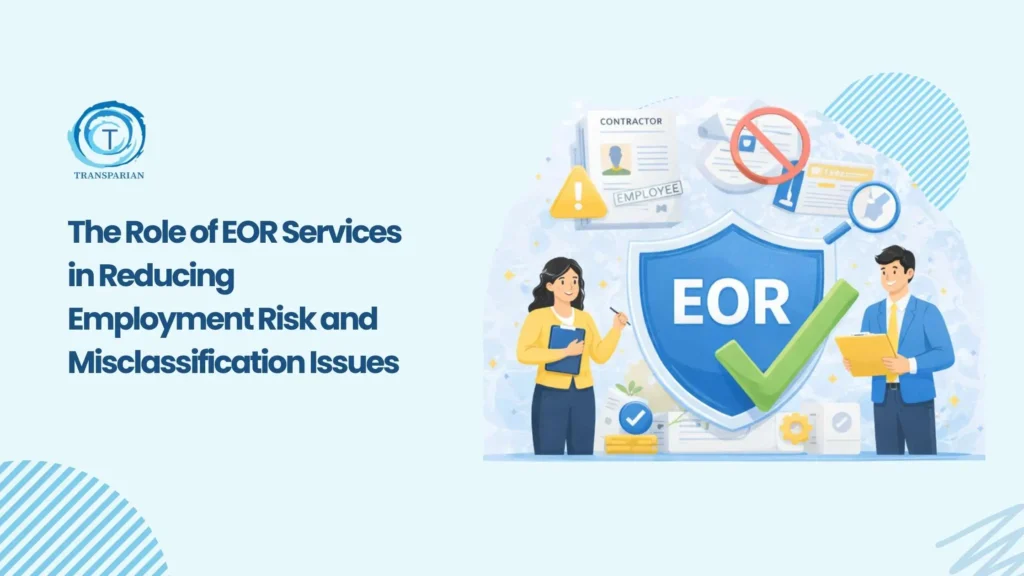
Among these risks, employee misclassification is one of the most common and expensive compliance failures.
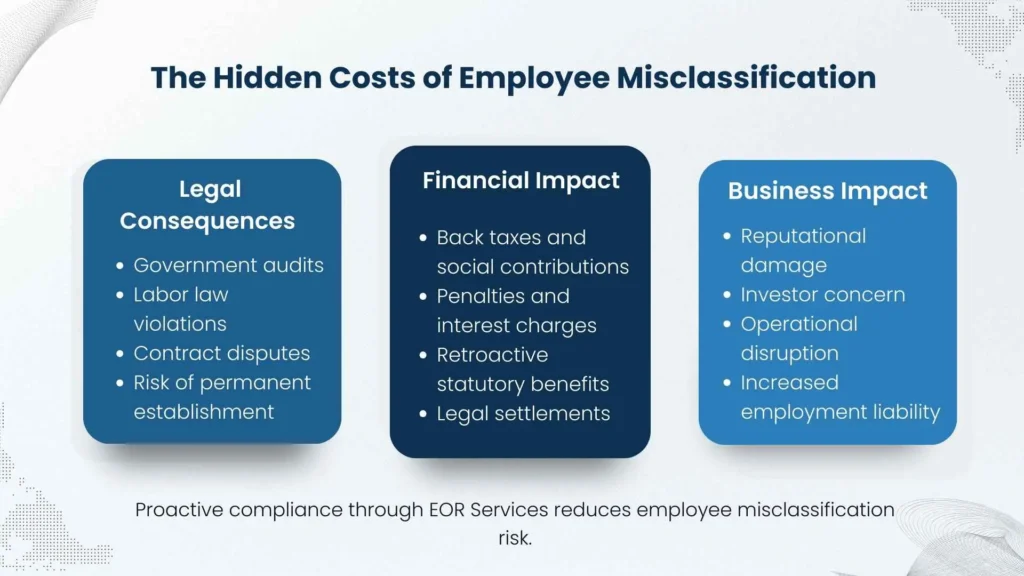
If a company treats someone as an independent contractor but authorities decide they are actually an employee, the company may face back taxes, social security payments, interest, and fines. In severe cases, this can lead to legal action or demands to pay owed benefits.
Understanding Contractor vs Employee Classification
One of the biggest compliance challenges in cross-border hiring is contractor misclassification.
Different countries use different tests to determine employment status. Authorities look at factors such as:
- Level of control over work
- Economic dependency
- Integration into company operations
- Provision of tools and equipment
- Exclusivity of service
Misusing these criteria increases the risk of employee misclassification, especially when companies use contractors for long-term or core business roles.
An EOR helps reduce this risk by formally employing workers in accordance with local labor laws. Instead of setting up a risky contractor arrangement, the EOR establishes a compliant employment structure that complies with regional regulations.
How EOR Services Ensure Labor Law Compliance
Labor law compliance varies widely between countries. Employment laws cover areas like minimum wage, leave entitlements, working hours, termination procedures, and severance.
An EOR assumes responsibility for:
- Drafting compliant employment contracts
- Registering employees with the social security authorities
- Managing statutory leave policies
- Handling termination in line with local regulations
- Maintaining legally required documentation
This local expertise helps prevent companies from unknowingly breaking employment laws. It also ensures employees receive legal protections, reducing the risk of disputes.
Strengthening Global Employment Compliance
As more companies expand internationally, compliance becomes much more complex. Each country has its own tax rules, benefits, and reporting requirements.
Global employment compliance requires centralized oversight combined with local expertise. An EOR integrates these elements by:
- Monitoring changes in employment legislation
- Ensuring correct worker classification
- Managing documentation for audits
- Aligning payroll processing with tax regulations
Without organized controls, businesses can face inconsistencies across borders. EOR frameworks help standardize processes while still respecting local differences.
International Payroll Compliance and Tax Accuracy
Payroll mistakes are a common reason for regulatory scrutiny. Errors in tax withholding, contributions, or payment timing can quickly lead to financial penalties.
Through international payroll compliance, EOR providers:
- Calculate income tax deductions accurately.
- Manage employer and employee social contributions.
- Issue compliant payslips
- Ensure currency conversions meet regulatory standards.
- File required payroll reports.
In addition, global payroll risk management helps companies avoid problems with tax misreporting and late payments. A well-organized payroll system reduces errors and keeps records ready for audits.
Managing Statutory Benefits and Social Contributions
Compliance with statutory benefits is often one of the most overlooked risks.
Governments mandate employer contributions toward:
- Social security
- Health insurance
- Provident funds
- Unemployment insurance
- Paid leave entitlements
Failure to properly enroll employees or to pay contributions on time may result in liabilities and penalties. EOR solutions ensure that all statutory registrations and payments are implemented in accordance with local labor codes.
This not only protects the organization but also enhances employee trust and retention.
Reducing Employment Liability Through Legal Employer Structure
When an organization recruits globally without a local firm, it becomes directly exposed to legal liabilities. Claims involving wrongful termination, wage claims, or benefit claims can arise quickly.
By acting as the legal employer, EOR providers help reduce employment liability. The EOR:
- Becomes the employer of record for legal purposes
- Handles employment disputes within local frameworks
- Ensures compliant termination processes
- Manages severance calculations
This model shields the client company from direct regulatory exposure while still allowing control over daily performance management.
Cross-Border Hiring Compliance and Permanent Establishment Risk
Beyond employment classification, expanding internationally without a proper structure can create corporate tax issues.
Improper hiring arrangements can trigger permanent establishment risk, in which authorities determine that a company has established a taxable presence in a country.
Through structured cross-border hiring compliance, EOR models:
- Prevent unauthorized local entity creation.
- Align employment contracts with tax standards.
- Reduce exposure to corporate tax claims.
- Maintain separation between operational management and legal employment.
This approach helps limit financial and reputational risks during global expansion.
The Overlooked Risk: Ongoing Classification Drift
Many companies focus on classification at the time of hiring, but ignore how roles evolve.
A contractor initially engaged for project-based work may gradually transition into a role resembling full-time employment. This phenomenon, often called classification drift, increases employee misclassification risk over time.
Modern EOR frameworks support:
- Periodic role reassessment
- Contract updates aligned with job scope changes
- Ongoing compliance reviews
- Documentation updates for audit readiness
This ongoing monitoring is rarely discussed but is crucial for reducing long-term risks.
Audit Readiness and Documentation Control
Government audits are on the rise in line with global workforce trends. The authorities usually scrutinize:
- Employment agreements
- Payroll records
- Tax filings
- Social contribution reports.
- Benefit enrollment form.
An EOR maintains centralized compliance records, making businesses audit-ready. Well-organized records help reduce response time and limit exposure during inspections.
Workforce Classification Automation and Compliance Technology
New compliance technologies are changing how companies prevent risks.
Advanced EOR platforms now incorporate:
- Classification assessment tools
- Automated compliance alerts
- Regulatory change tracking systems
- Digital contract lifecycle management
- Payroll reconciliation systems
By integrating compliance into daily operations, organizations reduce the need for manual oversight. Technology-driven global payroll risk management improves transparency and reduces systemic errors.
Cultural and Operational Risk Factors
Besides legal frameworks, internal management practices can also increase compliance risks if not handled carefully.
Treating contractors like employees, such as assigning set hours, requiring exclusivity, or including them in core teams, raises compliance concerns.
These models encourage clear onboarding, defined roles, and aligned policies, which help prevent contractor misclassification.
A Strategic Risk Mitigation Framework
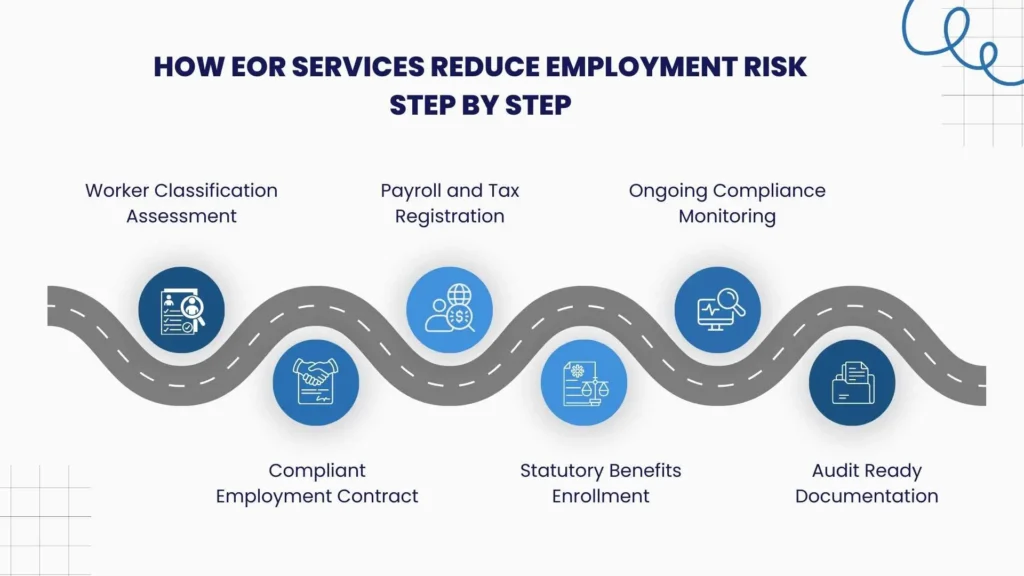
The most effective use of EOR Services goes beyond outsourcing payroll. It functions as a structured compliance strategy:
- Pre-hire classification assessment
- Compliant contract structuring
- Payroll and tax registration
- Benefits enrollment and reporting
- Ongoing compliance monitoring
- Audit documentation management
- Risk review during role evolution
This holistic approach strengthens global employment compliance while supporting operational agility.
The Business Impact of Structured Compliance
Reducing employment risk is not merely about avoiding penalties. It directly impacts:
- Investor confidence
- Employer branding
- Talent retention
- Operational continuity
- Market expansion speed
By keeping employment structures consistent with regulations, companies build a stable foundation for international growth.
EOR frameworks turn compliance from a one-off expense into a strategic advantage by ensuring organized payroll, proper statutory benefits, and proactive identification of misclassification risks.
As global hiring accelerates, companies that use strong compliance models in their expansion plans will be better equipped to handle changing labor laws and grow confidently across borders.
FAQ’s
EOR Services allow a third party to act as the legal employer on behalf of a company. The EOR manages employment contracts, payroll, taxes, and compliance, while the client company manages the employee’s daily work.
An EOR formally hires workers under local employment laws, eliminating ambiguity between contractor and employee status and significantly lowering employee misclassification risk.
Contractor misclassification occurs when a worker is treated as an independent contractor but legally qualifies as an employee. This can lead to penalties, back taxes, unpaid benefits, and legal disputes.
Yes. EOR solutions centralize and standardize global employment compliance by ensuring payroll, tax filings, employment contracts, and benefits align with local regulations in each country.
By acting as the legal employer, EOR providers help reduce employment liability, manage disputes, handle severance calculations, and ensure lawful termination processes.
Absolutely. EOR solutions simplify cross-border hiring compliance by preventing permanent establishment risks, aligning employment contracts with local laws, and managing country-specific tax obligations.