A founder with 80 employees tells a vendor, “We need help with HR.” One vendor offers payroll processing, statutory filings, and onboarding paperwork. Another offers a senior leader who will review the org structure, fix the pay bands, and sit in leadership meetings. Both answer the same sentence, and they solve very different problems.
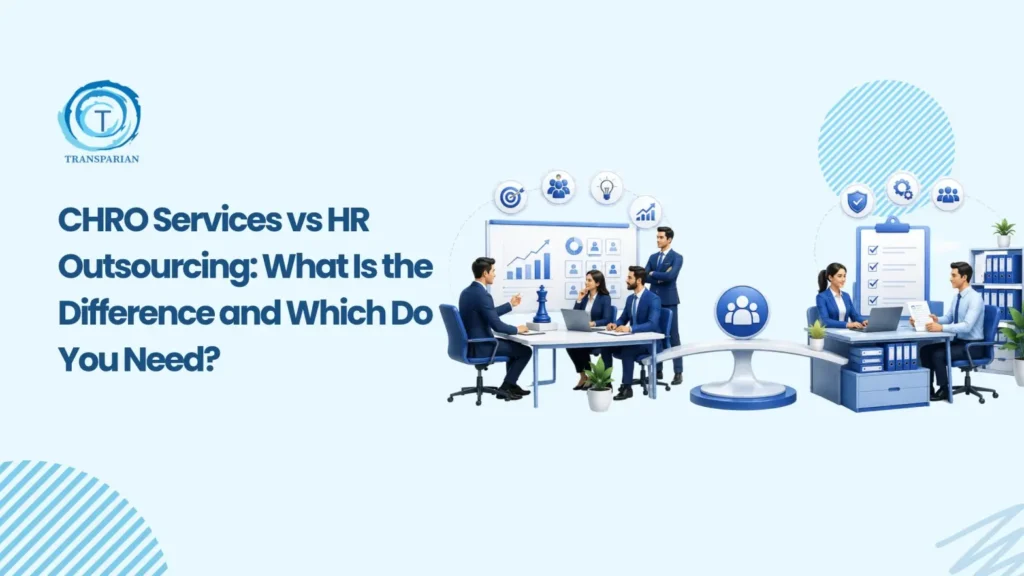
HR outsourcing and CHRO services get mixed up because both involve handing part of HR to someone outside the company. What gets handed over is the difference. One transfers tasks. The other transfers judgment. Choosing the wrong one costs months and money, so it helps to see where each fits.
What HR Outsourcing Covers
HR outsourcing means giving a defined set of operational tasks to an external provider. The provider runs a process, and the company receives a predictable output. Common scope includes:
- Payroll processing and payslips
- PF, ESIC, and professional tax filings
- Employee onboarding and documentation
- Leave and attendance administration
- Recruitment support for specific roles
- Contract staffing or EOR arrangements for workers on a partner’s payroll
The value is reliability and time. Work with fixed rules and fixed deadlines suits a team that does it daily across many clients. Your in-house HR person stops chasing filings and gets hours back.
What outsourcing does not do is decide anything. The provider issues the offer letter you approved, at the salary you set, under the structure you already have. If that structure is broken, the outsourced process will run the broken structure efficiently.
What CHRO Services Cover
CHRO services put senior HR leadership into the company, either full-time or, more often for growing firms, part-time. The scope is strategic and decision-heavy:
- Organization design and reporting lines
- Compensation architecture and pay bands
- Workforce planning linked to revenue targets
- Leadership development and succession
- Culture, engagement, and retention strategy
- Oversight of compliance and HR risk
- Advising the CEO on people decisions
A CHRO produces direction, frameworks, and decisions, then makes sure the team carries them out. Take a hiring plan as an example. An outsourced provider fills the roles on the list. A CHRO decides what belongs on the list, in what order, at what cost, and reporting to whom.
Companies looking for CHRO services in India often start part-time, because the leadership need is real long before the budget for a full-time executive exists.
The Core Difference at a Glance
| HR Outsourcing | CHRO Services | |
|---|---|---|
| Main focus | Executing HR tasks | Setting people strategy |
| Output | Processed work: payroll, filings, records | Decisions, frameworks, org design |
| Works with | HR team or founder | CEO and leadership team |
| Typical trigger | Too much admin, missed deadlines | Growth, attrition, leadership gaps |
| Measured by | Accuracy and timelines | Business outcomes such as retention and cost |
When HR Outsourcing Is Enough
Outsourcing fits when the problem is workload. Signs include:
- HR is one person buried in paperwork
- Compliance dates keep slipping
- Payroll errors or delays are becoming routine
- You are hiring many similar roles quickly
- Policies and structure are sound, but capacity is short
A company of 25 people with a clear structure and a stable team often needs exactly this and nothing more. Adding a CHRO to a company whose main problem is late filings would mean paying for the wrong skill.
When You Need CHRO Services
CHRO services fit when the problem is judgment. Signs include:
- People keep leaving and nobody can explain why
- Offers are negotiated case by case with no pay bands
- The founder still approves every hire
- New managers struggle and nobody trains them
- A funding round or acquisition is coming
- Nobody owns succession for key roles
Each of these has a specific fix. If people keep leaving, a CHRO strategy to reduce employee attrition begins with data on who leaves, under which managers, and after how long. If a deal is ahead, fractional HR leadership in M&A prepares the people side before signing. If key roles have no backup, succession planning in Indian SMEs needs an owner before it needs a document.
The timing question comes up often. The answer to when to hire a CHRO usually arrives earlier than founders expect, and scaling from 20 to 200 employees tends to be the stretch where informal HR stops working.
Can You Use Both?
Yes, and many companies do. Outsourcing handles volume work. The CHRO sets the rules those processes follow. A CHRO who designs the pay structure paired with an outsourced payroll provider who applies it is a common and sensible setup.
The reverse rarely works. Outsourcing alone cannot supply strategy, because a processing team is not asked to question the structure it was given. This is one reason businesses are moving beyond traditional HR consultancy toward leadership that stays involved after the advice is given.
Cost and Commitment
The two models are priced differently, which makes direct comparison misleading.
HR outsourcing usually scales with headcount or task volume. More employees means more payslips, filings, and onboarding files, so the cost rises as you grow.
CHRO services scale with scope and time. A full-time CHRO is an executive hire with a matching package. Fractional CHRO services work differently: a senior leader works a set number of days each month, and the company pays for that time. A fractional CHRO reduces HR costs by avoiding both the full-time salary and the cost of unfixed problems such as repeated bad hires. For many smaller firms, a fractional CHRO beats a full-time hire on cost and on how fast the work starts.
The in-house question matters too. Some companies weigh virtual HR against in-house HR before deciding how much of the function to keep inside.
Where Companies Go Wrong
Four mistakes show up repeatedly:
- Buying outsourcing to fix a strategy problem, then wondering why attrition did not change
- Hiring a CHRO who spends the first year correcting payroll errors because no operational support exists
- Choosing an advisor who delivers a report and leaves, when what the company needed was action-oriented CHRO services that implement and review
- Treating the choice as either/or when the company needs both
The third mistake is the most expensive. A well-written findings deck feels like progress, but nothing changes until somebody owns the follow-through.
How to Decide
Four questions sort most situations:
- Is the pain repetitive work, or unclear decisions?
- Who makes people decisions today, and do they have the experience to make them well?
- Is a funding round, acquisition, or rapid hiring ahead?
- Do you have a defined structure for pay, levels, and succession?
If the honest answer to the first question is workload, start with outsourcing. If it is decisions, start with CHRO consulting. If both apply, bring in the CHRO first, because that person defines what the outsourced team should execute. Then assign operational work to the provider with clear rules, and let the CHRO review results each month.
Not Sure Which One Fits Your Company?
Transparian’s CHRO services give growing companies experienced HR leadership for org design, compensation, compliance, and succession, without a full-time executive hire.
FAQ’s
HR outsourcing hands operational tasks such as payroll, filings, and onboarding to an external provider. CHRO services provide senior leadership that sets people strategy, designs the organization, and advises the CEO. One executes work, and the other decides what work should happen.
It typically covers payroll processing, statutory filings like PF and ESIC, onboarding, leave and attendance administration, and recruitment support. Some providers also offer contract staffing or EOR arrangements. The scope is defined in advance and the output is repeatable.
They include organization design, compensation structure, workforce planning, leadership development, succession planning, and compliance oversight. The CHRO also advises the CEO on hiring, promotions, and restructuring. The focus is decisions and frameworks, not processing.
Yes, and the combination is common. The CHRO sets policies and structure, while the outsourced provider runs the day-to-day processes under those rules. This gives you strategy and execution without building a large in-house team.
When the problems shift from workload to judgment. Rising attrition, inconsistent pay, founder-approved hiring, and missing succession plans are common signals. A coming funding round or acquisition is another strong trigger.
Ask who will do the work and how many days a month they will spend on it. Check for implementation support, not only advice, and ask what changes in the first 90 days. Also confirm the provider understands Indian labour law, PoSH requirements, and compliance obligations.