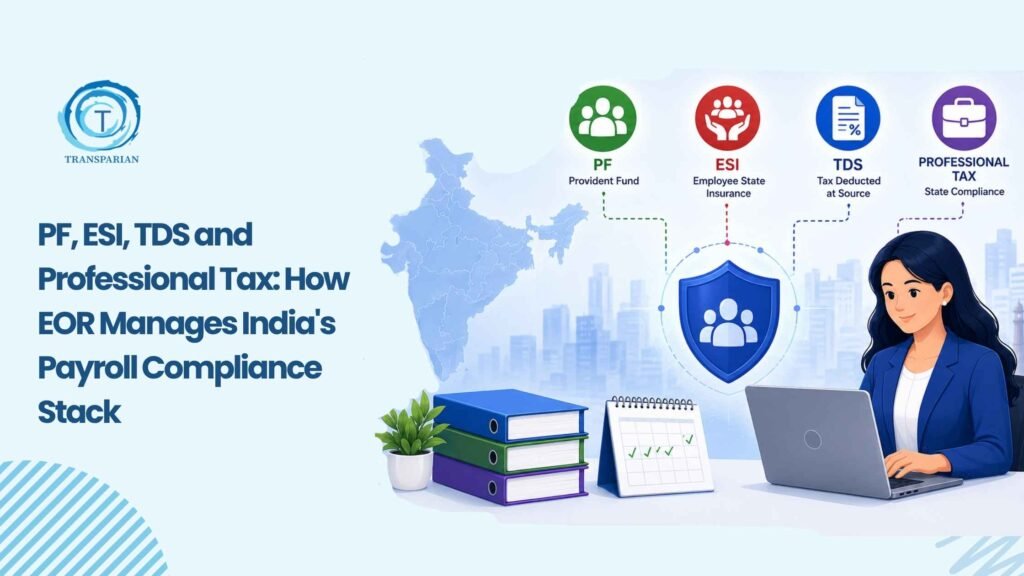
India payroll looks manageable from the outside. Process salaries, deduct taxes, pay on time. In practice, it’s a multi-layer compliance system where each component has its own eligibility thresholds, contribution rates, filing deadlines, registration requirements, and penalty structure and where getting one layer wrong tends to ripple through the others.
For foreign companies hiring in India, or Indian companies expanding across states, this is often the first real compliance hurdle. Not because the rules are impossible to understand, but because staying current, accurate, and on-schedule across all four obligations simultaneously requires dedicated infrastructure that most hiring teams don’t have set up from day one.
That’s the operational problem that EOR services are built to solve. Rather than building that infrastructure in-house, companies outsource the legal employer role to a partner who already has it and who carries the compliance responsibility every month.
Here’s what that compliance stack actually looks like, and what managing it properly requires.
Provident Fund: The Baseline Obligation
Provident Fund is the most familiar of the four components, and in many ways the most consequential if mishandled. Under the Employees’ Provident Funds and Miscellaneous Provisions Act, 1952, any establishment with 20 or more employees is required to register with the EPFO and begin contributions.
The rate is 12% of basic wages from the employer and 12% from the employee. Of the employer’s 12%, the bulk goes to the EPF account, while 8.33% is directed to the Employees’ Pension Scheme (EPS), subject to a monthly salary ceiling. Monthly challans are due by the 15th of the following month, and the ECR (Electronic Challan cum Return) must be filed accurately to keep contribution records current.
Where companies tend to go wrong:
- Using the wrong salary definition, PF is calculated on basic wages, not gross salary
- Missing the registration threshold, whether by oversight or because headcount crept up gradually
- Using contractor arrangements specifically to stay below the 20-employee mark, which creates real misclassification risk when those arrangements look like regular employment in practice
That last point is where regulatory scrutiny has been sharpening. EPFO inspectors pay close attention to establishments where headcount sits just below the threshold, and retrospective coverage orders going back years are not uncommon.
ESI: Dual Contributions, Salary Thresholds, and Branch-Level Registrations
Employee State Insurance applies to employees earning up to ₹21,000 per month (₹25,000 for employees with disability) in establishments with 10 or more employees in most states. The contribution split is 3.25% from the employer and 0.75% from the employee, both calculated on gross wages.
Contributions must be deposited by the 15th of the following month. Half-yearly returns are filed in May and November for each contribution period. Each establishment location typically needs its own ESIC registration, which means companies with offices, branches, or plants across states have to maintain separate registrations and track filings for each.
The coverage threshold is also a live compliance issue, not a one-time setup decision. When an employee’s salary crosses ₹21,000 after an increment, they exit ESI coverage from the following contribution period. Managing those transitions accurately especially where a large portion of the workforce sits near the threshold requires close payroll attention every month.
TDS on Salary: Section 192 and the Quarterly Filing Cycle
TDS under Section 192 of the Income Tax Act is the employer’s obligation to deduct income tax from salary before disbursement. Unlike most other TDS provisions, there is no fixed rate. The deduction is based on each employee’s projected annual income, their declared investments under Chapter VI-A (Section 80C, 80D, and others), any applicable exemptions like HRA, and the tax regime they have opted into.
Every month, the employer estimates the annual tax liability for each employee, apportions it across the remaining months of the financial year, and deducts accordingly. At year-end, the calculation is reconciled against actual earnings and investment proofs submitted.
TDS must be deposited with the government by the 7th of the following month. Form 24Q, the quarterly TDS return for salary must be filed in July, October, January, and May.
The stakes are meaningful. Late deposits attract interest at 1.5% per month, and failure to deduct at all attracts 1% per month. Form 16, the TDS certificate issued to employees for their personal ITR filing is generated directly from Form 24Q data. Any error at the filing stage shows up in the employee’s own tax documents and becomes a trust issue between employer and employee that’s hard to walk back.
Professional Tax: State-Specific, Easy to Overlook
Professional tax is a state-level levy with no national uniformity. The states that impose it, the salary slabs used to calculate it, the applicable rates, and the filing frequencies are all determined independently by each state government.
States that levy professional tax include Maharashtra, Karnataka, Andhra Pradesh, Telangana, Tamil Nadu, West Bengal, Gujarat, and Madhya Pradesh, among others. States like Delhi, Uttar Pradesh, Rajasthan, and Haryana do not. Maharashtra’s maximum professional tax is ₹2,500 per year. Karnataka operates on a different slab structure with its own rates. No two states are identical.
Employers must register in each state where they have employees, deduct the applicable amount from salaries, remit it to the state authority on the required schedule, monthly in some states, annual in others and maintain separate records for each.
For companies operating across multiple states, this means parallel registrations, different slab calculations by employee location, and different filing deadlines running simultaneously. It’s the obligation that gets underestimated at setup and discovered during inspections when a notice arrives for non-registration in a state that slipped through.
Why the Stack Is Hard to Run Alone
Each of these obligations is manageable in isolation. The difficulty is running all four correctly, in parallel, month after month, while also processing payroll for new joiners and exits, handling mid-year salary revisions, collecting investment declarations, and keeping everything synchronized across states.
Companies entering India for the first time consistently underestimate this. PF and TDS are on most teams’ radar. ESI threshold management and professional tax registrations across states often are not. The compliance load compounds as headcount grows, and the cost of falling behind penalty interest, back-contribution demands, ESIC and EPFO inspections tends to arrive in a lump, not as a gradual warning.
An EOR absorbs this entire stack. Registrations across all applicable schemes, monthly payroll with correct deductions, challan payments filed on time, quarterly TDS returns, half-yearly ESI filings, and state-specific professional tax remittances, all of it sits with the EOR, not with the client company’s finance or HR team.
This matters particularly when audits, inspections, or due diligence processes happen. When investors, acquirers, or regulators look closely at employment records, a well-managed EOR arrangement produces clean contribution histories, documented filings, and no gaps that need explaining under pressure.
What the Monthly Cycle Actually Looks Like
When a company hires through an EOR in India, the payroll cycle each month runs something like this:
- The client provides salary inputs — new joiners, exits, increments, variable pay
- The EOR calculates gross-to-net for each employee, applying PF, ESI, TDS, and professional tax based on each person’s applicable rates and declarations
- PF and ESI challans are deposited by the 15th of the following month
- TDS is deposited by the 7th of the following month
- Professional tax is remitted to the relevant state on the required schedule
- ECR, Form 24Q, ESIC returns, and professional tax filings are submitted on schedule
- Employees receive accurate payslips and, at year-end, Form 16s generated from clean Form 24Q data
None of this requires the client company to hold separate registrations with each statutory body, maintain an in-house payroll team in India, or track four different filing deadlines across multiple states. That infrastructure already exists on the EOR’s side. It also means companies don’t have to treat speed and compliance as competing priorities, getting onto payroll in India quickly without cutting corners on any of these obligations is exactly what the model delivers.
Let Transparian Simplify Your Global Hiring
From PF and ESI contributions to accurate TDS deductions and state-specific professional tax filings, Transparian provides end-to-end EOR services for companies hiring in India. With 20+ years of HR and compliance experience, Transparian ensures India payroll is processed correctly, filed on time, and audit-ready every month.
FAQ’s
Employers contribute 12% of an employee’s basic wages toward EPF. Of this, 8.33% is directed to the Employees’ Pension Scheme (EPS), subject to a monthly wage ceiling of ₹15,000. Employees contribute a matching 12%, making the total combined PF contribution 24% of basic wages per month.
ESI covers employees earning up to ₹21,000 gross per month (₹25,000 for employees with disability) in establishments with 10 or more employees. Once an employee’s salary crosses the threshold typically after an increment, they exit ESI coverage from the start of the following contribution period.
TDS on salary is calculated based on each employee’s projected annual income, their chosen tax regime (old or new), and declared deductions under Chapter VI-A. The estimated annual tax liability is spread across the remaining months of the financial year and deducted proportionally each month, then reconciled at year-end against actual earnings and investment proofs.
Late PF deposits attract damages ranging from 5% to 25% per annum depending on the delay period, plus interest at 12% per annum on outstanding amounts. Delayed ESI contributions attract similar interest. Repeated or wilful non-compliance can lead to prosecution proceedings under the Employees’ Provident Funds Act or ESI Act.
A foreign company without a registered Indian entity cannot directly hold PF or ESI registrations. To hire compliantly, they need either a local subsidiary or an Employer of Record. An EOR already holds these registrations and manages all statutory contributions on behalf of the company, making it the fastest compliant route to hire in India.
An EOR maintains professional tax registrations in each state where employees are based. For companies with employees spread across states, the EOR applies the correct state-specific slab rates, remits professional tax to each state authority on the required filing schedule, and manages all registrations separately without the client company needing to independently track each state’s rules, deadlines, or rates.