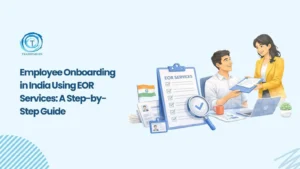
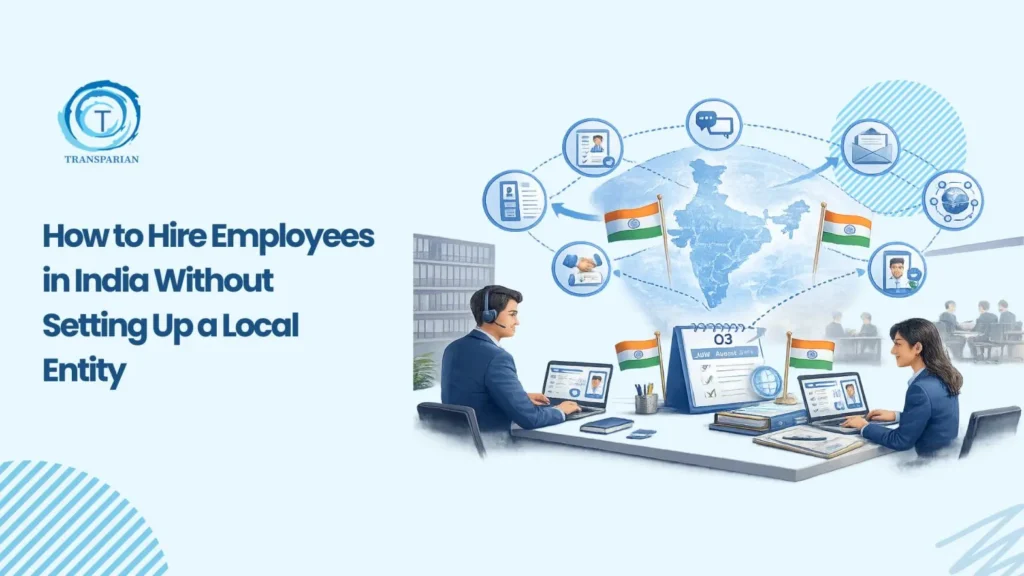
Foreign companies can hire employees in India without a local entity through three routes: Employer of Record (EOR), independent contractor arrangements, or a Professional Employer Organization (PEO). For most small to mid-size hiring scenarios, EOR is the most practical option — it puts someone on compliant Indian payroll in two to three weeks, covering PF, ESI, TDS, and professional tax, with no entity registration required.
Most foreign companies that want to hire in India hit the same wall early on. They find the right candidate, sometimes two or three, and then someone asks the question that stalls everything: how do we actually put this person on payroll when we don’t have a registered entity here?
Setting up a legal entity in India is not quick. Registration, tax identification, PF and ESIC setup, state-specific licenses, opening a local bank account, the process takes three to four months when things go smoothly and longer when they don’t. For a company trying to hire one procurement manager or a clinical research coordinator in Pune, that timeline is simply not practical.
The good news is that entity setup is not the only path. There are three legitimate routes to hiring in India without a local entity, and which one fits depends on what the role actually looks like, how long the engagement will run, and how much operational control you need over the person’s work.
Route 1: Employer of Record
The cleanest option for most hiring scenarios is working with an EOR services provider. An Employer of Record becomes the legal employer of your India-based hire. They hold the statutory registrations, process payroll, handle PF and ESI contributions, manage TDS filings, and take on the employer-side compliance obligations. You keep full control over what the person actually does their role, their deliverables, their day-to-day work.
From the employee’s perspective, they have a proper employment contract, statutory benefits, and a clear employment relationship. From your side, you have someone working within your team structure without the overhead of maintaining a legal entity in India.
The time advantage here is significant. A good EOR can have someone employed and payroll-ready in two to three weeks from contract signing. That compares to three months or more for entity registration. For companies that need to move fast, or that are not sure yet whether India will be a long-term market for them, EOR removes a structural barrier that would otherwise slow everything down.
One thing worth being clear about: EOR works well when you want the person to function as a genuine member of your team. If you need direct oversight of their work and want them integrated into your operations, this is the right structure. It is not the right structure for handing off a function entirely and walking away from it.
Route 2: Contractor Arrangement
Some companies go the contractor route, particularly for roles that are genuinely project-based. An independent contractor relationship in India is simpler to set up than employment, requires no statutory contributions from the engaging company, and works fine when the arrangement is structured correctly.
The problem is that contractor arrangements get misused. A lot of companies engage people as contractors not because the work is genuinely independent and project-based, but because it’s the path of least resistance. When a “contractor” is working fixed hours, under close supervision, on work that’s central to the company’s operations, misclassification risk starts to build. Indian tax authorities and labor inspectors have become more attentive to these arrangements over the past few years. A reclassification finding can mean back taxes, penalty interest, and retroactive statutory benefit obligations covering the full period of engagement.
Contractor is a legitimate option when the role genuinely fits the description. It’s the wrong choice when it’s being used to avoid the complexity of proper employment.
Route 3: Professional Employer Organization (PEO)
A PEO is sometimes confused with EOR, but they work differently. Under a PEO arrangement, the employing company typically needs some form of local presence or registration already in place. The PEO then provides co-employment services, sharing employer responsibilities across HR administration, payroll, and benefits.
In India, PEO arrangements are less common than EOR for foreign companies precisely because they tend to assume some existing local footprint. If you have nothing at all in India yet, EOR is almost always the more practical starting point.
What Payroll Compliance Actually Looks Like in India
Understanding what goes into Indian payroll compliance helps explain why most companies prefer to have an EOR carry it rather than figure it out themselves.
Every month, a compliant Indian employer has to manage:
- Provident Fund contributions (12% employer, 12% employee, split across EPF and EPS)
- ESI contributions for employees earning up to the notified wage ceiling
- TDS on salary, calculated based on the employee’s estimated annual income and declared deductions
- Professional tax, which varies by state and applies in Maharashtra, Karnataka, West Bengal, and several others
Each of these sits under a different regulatory framework. PF is administered by the EPFO, ESI by the ESIC, TDS by the Income Tax Department, and professional tax by individual state governments. Filing schedules, challan formats, and penalty structures differ across all of them. The legal and financial compliance burden this creates is real, and it compounds quickly when you have employees in more than one state.
An EOR handles all of it. Not just payroll processing, but the underlying registrations, the monthly deposits, the return filings, and the reconciliations that tie everything together. The company just reviews payroll outputs and approves disbursement.
The Employment Lifecycle Beyond the Hire
Most conversations about hiring in India without an entity focus on getting someone onto payroll. The full lifecycle is longer and has more compliance touchpoints than that.
Onboarding in India involves UAN generation for PF, ESIC registration, Aadhaar and PAN seeding, and in some cases state-specific registration requirements. Employee onboarding done sloppily creates problems that take months to clean up. Salary revisions need to be reflected correctly in PF calculations and TDS projections. Exits, terminations, and final settlements have to follow the procedures prescribed under the applicable state’s Shops and Establishments Act, and notice periods and gratuity obligations need to be handled correctly.
A well-run EOR handles the full employment lifecycle from onboarding through to exit, not just the initial month of payroll. This matters especially for companies that go through due diligence, whether for investment, acquisition, or regulatory inspection. Clean records across the full engagement are what audit readiness actually looks like in practice.
What This Approach Costs vs. What It Saves
The cost comparison between EOR and entity setup is not complicated, but it often gets glossed over. Entity registration in India involves legal fees, accounting fees, tax registrations, state-specific licenses, and a recurring compliance burden even during periods when you have few or no employees. An EOR charges a per-employee monthly fee that covers employment, payroll, and statutory compliance.
For small hiring volumes one to ten people, the EOR is almost always less expensive in real terms, not just in upfront cost. The time and cost argument for EOR is strongest at this scale, where the overhead of entity maintenance is disproportionate to the size of the team.
As headcount grows and the market proves itself, the math changes. Most companies that end up with twenty or thirty people in India eventually move toward their own entity. EOR is often the right starting point that makes that eventual entity setup a deliberate strategic choice rather than a rushed response to a hiring need.
What to Look for in an EOR Partner for India
Not all EOR providers know India well. A few things worth checking before signing on:
- Do they hold their own statutory registrations in India, or are they reselling another provider’s services?
- Can they handle state-specific professional tax and labor compliance, not just central statutory obligations?
- What does their actual track record look like on payroll accuracy and filing timeliness?
- How do they handle employee exits and final settlements under Indian labor law?
Pricing transparency matters too. The total cost of an EOR engagement in India should include the employee’s salary, all statutory contributions, and the EOR service fee, laid out clearly with no costs buried in the terms.
Let Transparian Simplify Your Global Hiring
From drafting compliant employment contracts to managing payroll, PF, and ESIC filings for every hire, Transparian provides reliable EOR services for companies looking to hire in India without setting up a local entity. Through accurate payroll processing and experienced HR compliance support, Transparian helps businesses hire faster, stay compliant, and keep their statutory records audit-ready every month.
FAQ’s
Yes. An Employer of Record holds legal employer status in India, manages contracts, payroll, and statutory filings, and lets your company direct the employee’s work without needing your own entity registration.
A subsidiary is a registered Indian entity that employs workers directly — setup takes three to four months with ongoing compliance costs attached. An EOR employs workers on your behalf from day one. Most companies use EOR to enter quickly, then consider a subsidiary once the team has scaled.
Two to three weeks from contract signing and KYC document collection. Entity registration takes three to four months by comparison. For companies that need to move quickly, EOR is usually the only structure that can match that timeline.
It is legal when the work is genuinely independent and project-based. Problems start when a contractor works fixed hours under close supervision on core business work. Indian tax and labor authorities increasingly flag this as misclassification. EOR is the safer structure for roles that function like employment.
Yes. A well-structured EOR handles state-specific obligations; professional tax registrations, Shops and Establishments Act compliance, and local labor law requirements across all relevant states, saving companies from managing multiple different regulatory frameworks simultaneously.
Usually when the India team reaches fifteen to twenty-five people, or when the market is clearly a long-term play. At that headcount, per-employee EOR fees become comparable to running a small entity, and direct control over statutory registrations starts making operational sense.